
Deck sanding is the process of machine-sanding a timber deck back to fresh, bare timber so a new coating can bond properly and last. At Sydney Deck Maintenance, it is the core of everything we do. We sand every deck with professional machines and dust-controlled extraction rather than relying on chemical strippers or high-pressure blasting, because bare, clean timber is the only surface that gives you a finish worth paying for.
We have worked with more than 3,000 residential clients across the Sutherland Shire over the past 15 years. Every quote is free, on site and done by Niall personally.
Deck sanding removes the top layer of weathered timber, along with any old oil, stain, mould, dirt and splinters, to expose sound timber underneath. Once a deck is back to bare timber, it can absorb a fresh coating evenly, and the colour and grain come back to life.
Think of it like painting a wall. A painter does not roll a new coat over flaking paint and expect it to last. Deck coatings are the same: they are only as good as the surface you apply them to.
Sanding does three jobs at once:
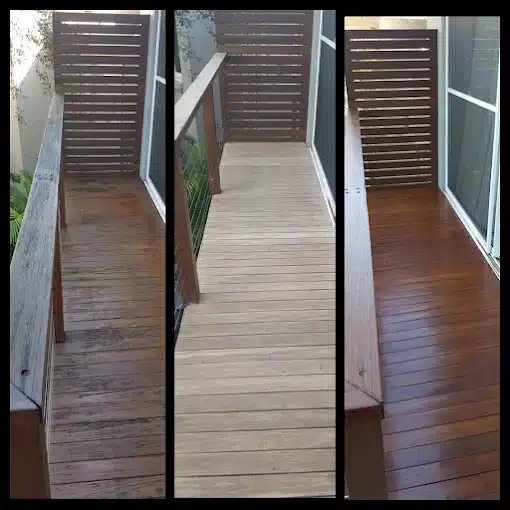
We sand because it gives a better and longer-lasting result than the two shortcuts most of the market relies on.
| Method | What it does | The problem |
|---|---|---|
| High-pressure blasting | Water at high pressure strips the surface | Gouges soft earlywood, raises a furry grain, forces water deep into the boards and can leave wand marks that show through the new coat |
| Chemical strippers and washes | Dissolve or lift old coatings | Can darken or blotch timber, need careful neutralising, run off into gardens and pools, and leave grey timber underneath |
| Full machine sanding (our method) | Physically removes coating and weathered timber | Takes more skill and better equipment, which is why most operators avoid it |
Pressure blasting is fast, which is why it is popular. The catch is that it often damages the very timber you are trying to protect. Once the fibres are torn, the deck feels rough, absorbs coating unevenly and greys again quickly. We are regularly called in to fix decks that have been blasted or washed and then coated by someone else.
Your deck needs sanding if any of these sound familiar:
If you are not sure, send us a few photos through our quote form. Niall can usually tell from photos whether a deck needs a full sand or a lighter maintenance coat.
Every deck is different, but our sanding process follows the same sequence so nothing is missed.
We check the timber species, board condition, fixings, moisture levels and existing coating, and identify any boards that need replacing first.
Furniture and pot plants are moved, and we protect walls, doors, glass and garden beds near the deck edges.
Raised nails are punched below the surface so they cannot tear the sanding paper or catch a foot later. Loose boards are re-fixed.
Rotten, split or badly cupped boards are swapped out before sanding, so the whole deck is sanded level together. See our deck repairs and board replacement service.
A coarse grit cuts through the old coating, mould and grey timber. Badly neglected or poorly coated decks may need two passes at this stage.
A finer grit removes the coarse scratch pattern and leaves a smooth surface that takes coating evenly.
Edges, corners, steps, fascia boards and handrails are sanded with smaller machines and by hand where large sanders cannot reach.
Our sanders run with dust extraction, and the deck and gaps between boards are vacuumed and cleaned before any coating goes on.
The bare timber is coated with two to three coats of the oil or stain you choose. See our deck oiling and staining service.
Dust-controlled sanding means our machines capture most of the timber dust at the source instead of blowing it across your garden, pool, windows and neighbours’ yards. It is one of the main reasons customers choose us.
Uncontrolled sanding dust gets into pool water, outdoor furniture cushions, air-conditioning units and open windows. It is also a nuisance for neighbours, which matters in apartment buildings, terraces and strata schemes. Extraction also gives a cleaner surface to coat, because less fine dust settles back into the timber grain.
We sand every common Sydney decking timber. Each species behaves differently under the sander and when coated, so we adjust our approach to suit.
| Timber | What it is like to sand | What we watch for |
|---|---|---|
| Merbau (also sold as kwila) | Medium to hard, sands well | Heavy tannin bleed, especially on newer decks, which stains concrete and paving nearby |
| Spotted gum | Very hard and dense | Resists oil penetration, so a fine sand and the right product matter. Prone to swelling and minor cupping |
| Blackbutt | Hard, pale and even | Shows dirt and mould readily, and greys quickly without protection |
| Jarrah | Hard, rich red | Older jarrah decks often have deep weathering and need extra coarse passes |
| Ironbark and tallowwood | Very hard | Slow to sand. Tallowwood is naturally oily, which affects coating choice |
| Treated pine | Soft | Easy to over-sand and gouge. Needs a lighter touch and more frequent recoating |
If your deck is a mix of timbers because boards have been replaced over the years, tell us during the quote. We can often blend different timbers with a tinted stain rather than replacing sound boards.
These are recent jobs from our project gallery.
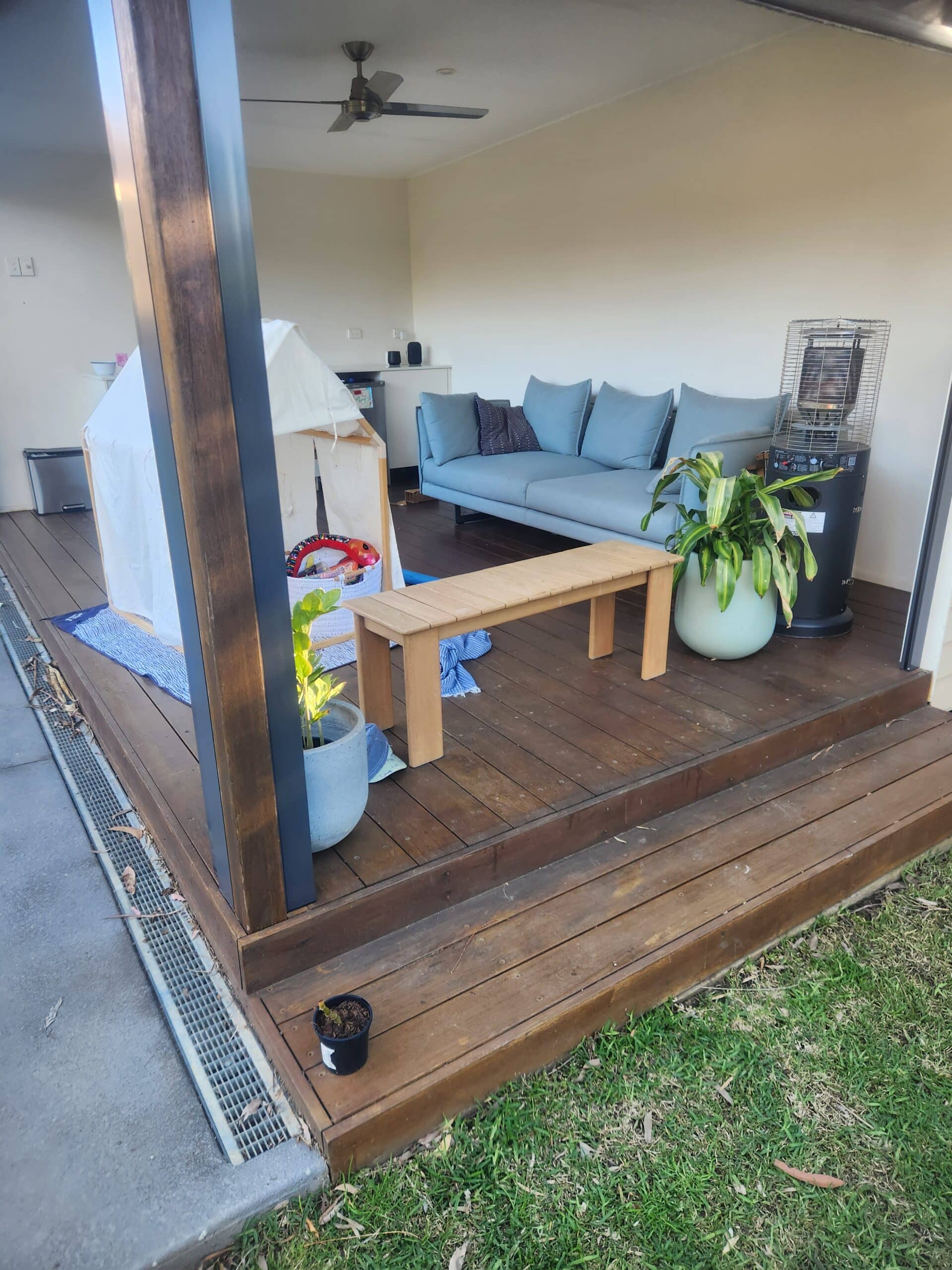
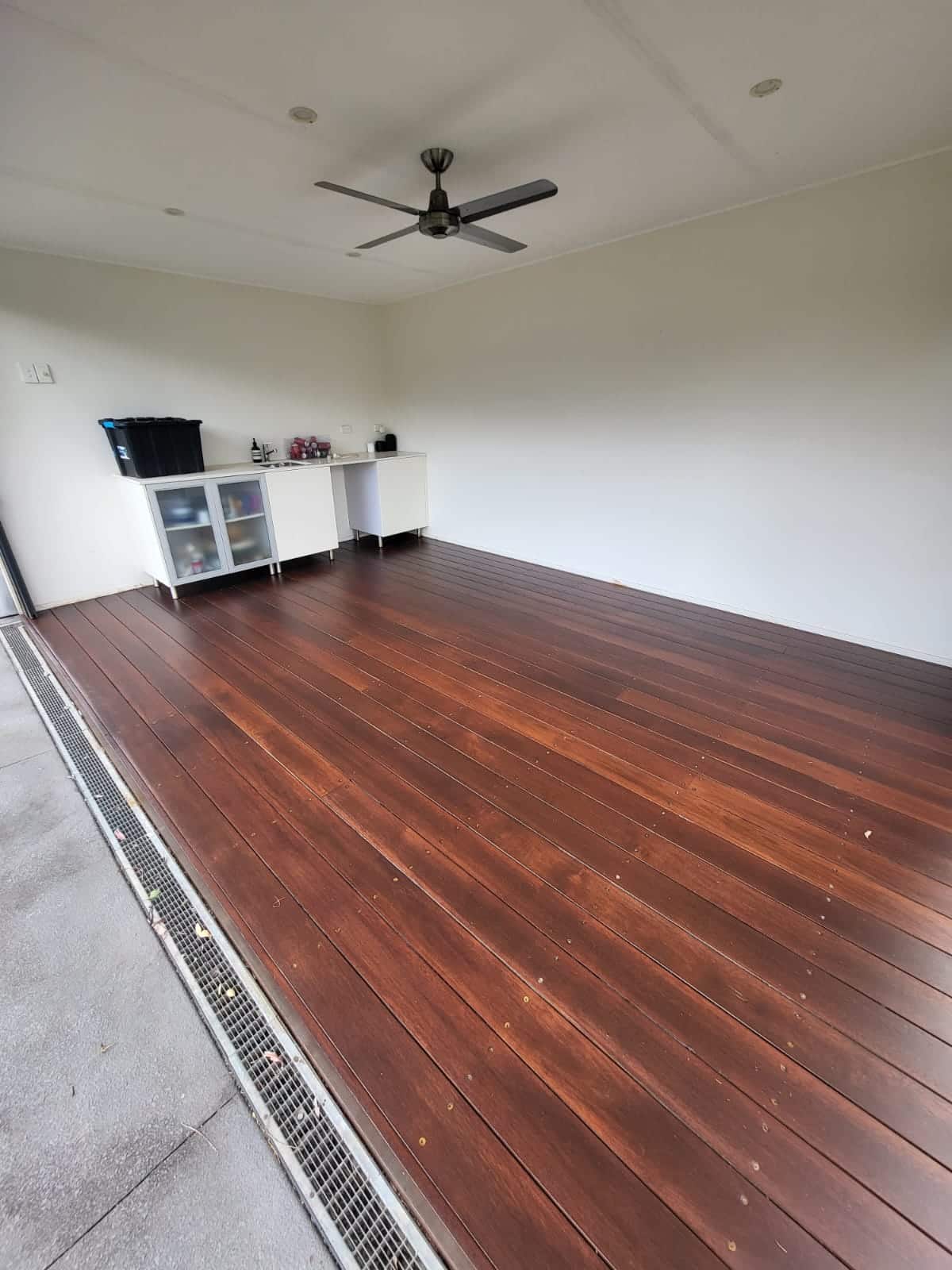
Years of family use and missed maintenance had left this deck dull and scratched. We sanded back to bare timber, removing old coating, scratches and dirt, then applied H2Oil Natural Stain. It came up like new.
As part of a full house renovation, this family’s spotted gum deck had swollen, warped and gone tired. Full machine sanding removed the dirt and old coating and also flattened the boards, giving them a far more even surface to walk on before it was fully restored.
This balcony deck had been stained by a local handyman the year before and the customer was unhappy with the result. We sanded it in two stages to remove the failed stain completely, then applied three coats of H2Oil Natural Stain. The whole job was done in one day.
The deck had been used as a trampoline base for five years, and the owners wanted to turn it into a relaxing adult space. Sanding back to bare timber removed the wear, marks and weathering and brought the deck back to life.
Most residential decks are sanded and coated within one to three days, weather permitting. A typical deck is sanded in the morning and receives its first coat the same day.
The main things that extend the timeframe are:
You can usually walk on the deck in socks within a few hours of the final coat. Furniture should go back once the coating has fully dried, which we will advise on the day for the product used.
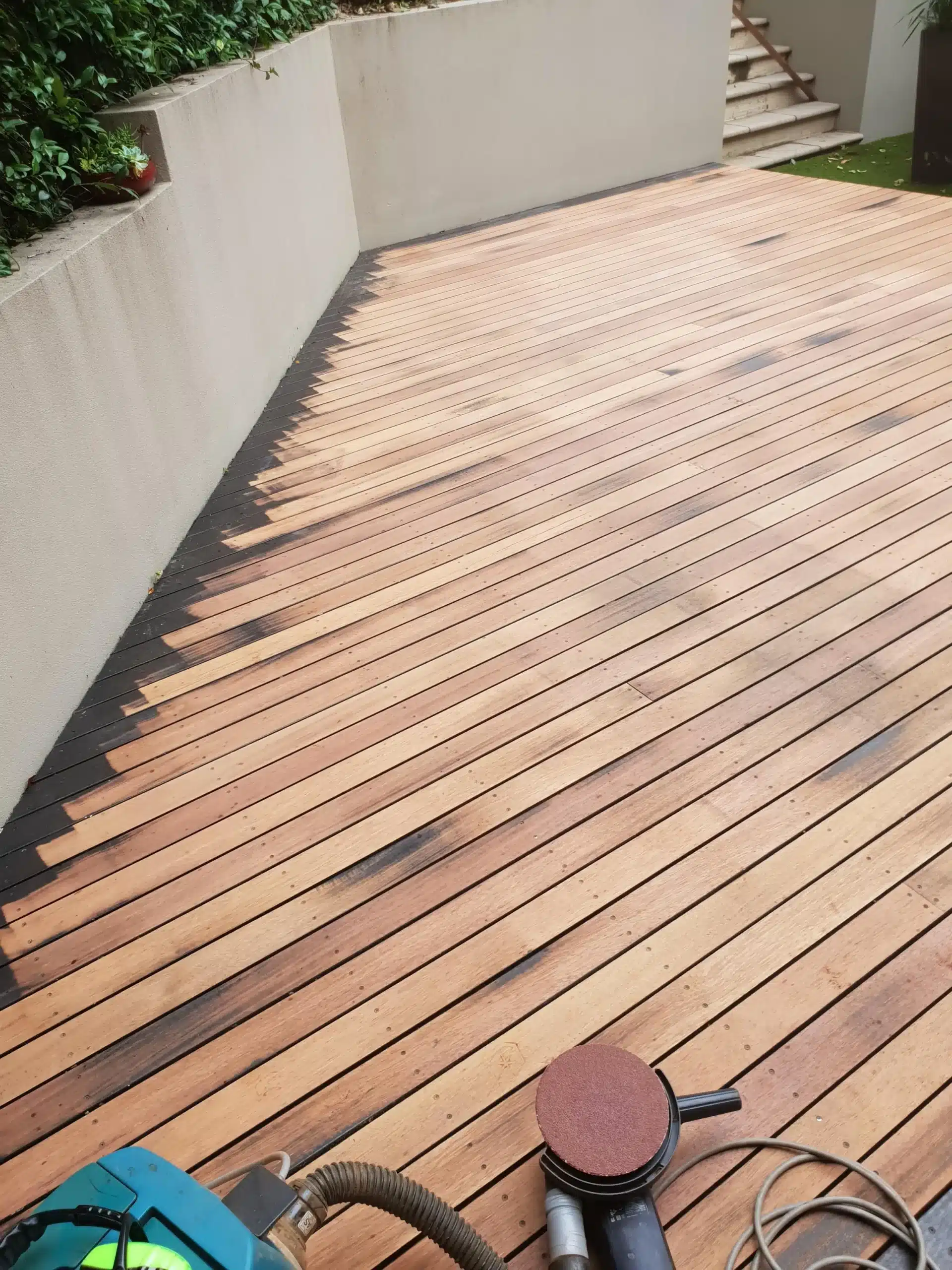
Deck sanding cost in Sydney depends mainly on the size of the deck and how much work it needs before coating. Every deck gets a free, fixed on-site quote, but these are the factors that move the price:
In our experience, the cheapest quote is often the one that skips sanding altogether. One of our customers had three quotes that were thousands of dollars more than ours. Another had paid a handyman, then paid us to sand it back and do it again. Sanding properly the first time is the cheapest option over the life of a deck.
You can sand a small deck yourself, but most homeowners find it harder than expected. Hire-shop drum and belt sanders are heavy, aggressive and easy to gouge timber with, especially at the edges and on softer boards. A small orbital sander is safer but very slow on anything bigger than a balcony.
If your deck is large, multi-level, coated with a stubborn finish or made of very hard timber, professional sanding will be faster and the result noticeably better.
A well-maintained deck only needs a full sand when the coating has failed or the timber has greyed. If you recoat every 12 to 18 months, a light buff sand and fresh coats are usually all that is needed, and a full restoration may be years away.
Decks that are left until the coating has gone completely will need a full sand every time. Our deck cleaning and maintenance programme is designed to stop that happening.
We also look after decks for strata schemes, hotels, real estate agencies and building managers, including JLL, Frasers Property and Crowne Plaza.
No, not when it is done properly. Professional sanding removes only a thin layer of weathered timber, far less than the damage a pressure washer can do. Most decking boards can be sanded many times over their life.
Yes, if the old coating has failed or the timber has greyed. Coating over grey timber or a peeling finish traps the problem underneath, and the new coat will fail early. A deck in good condition may only need a light buff sand before recoating.
Yes, but most new decks should weather for two to four months before coating, so the timber can release its natural oils and tannins. A light sand before the first coat then opens the grain and gives a better bond.
Yes. Painted decks take longer because paint is thicker and clogs abrasives. We will assess whether sanding is practical during the quote.
Sanding flattens minor cupping and raised edges. Badly warped, split or rotten boards should be replaced instead, which we can do as part of the job.
No. As long as we have access to the deck and a power point, you do not need to be home. Most customers let us in, head to work and come home to a finished deck.
You can usually walk on it lightly within a few hours of the final coat. Allow longer before replacing heavy furniture or pot plants. We will give you exact times for the product used.
We service the Sutherland Shire and the St George area up to Botany. Recent sanding jobs include Cronulla, Caringbah, Gymea Bay, Sylvania, Menai, Maroubra and Kensington.
Upload a few photos of your deck through our quote form or call Niall on 0449 183 440. We will tell you whether your deck needs a full sand or a lighter maintenance coat, and give you a fixed price on site.