
A non-slip deck coating adds a textured, slip-resistant finish to timber so it stays safer underfoot when wet. At Sydney Deck Maintenance, we create it by adding a grip additive into the staining process on a properly sanded deck. The grain still shows, the timber is protected, and pool areas, steps and walkways become far less slippery.
We recommend it for poolside decks, family homes with young children, homes with older residents, shaded entries and commercial areas with heavy foot traffic. Every quote is free and done on site by Niall.
Timber decks become slippery mainly because of moisture combined with mould, algae or a smooth surface film. In Sydney, the usual causes are:
Cleaning the mould off helps, but only for a while. A lasting fix combines a clean, sanded surface, a protective coating that discourages regrowth, and a texture that gives feet something to grip.
If you have young children, older parents or guests visiting your pool, slip resistance is one of the most useful upgrades you can make to a timber deck.
There are several ways to make a timber deck less slippery. This is how the main options compare.
| Option | How it works | Pros | Cons |
|---|---|---|---|
| Grip additive in the stain (our method) | Fine grit mixed into the coating creates a textured surface | Keeps the timber look, protects as it grips, applied in the same visit as staining | Slightly rougher underfoot. Texture wears in heavy traffic and is renewed at recoat time |
| Clear anti-slip topcoat | A clear coating with micro-aggregates applied over the timber | Clear finish, extra grip on top of an existing coat | Film coatings can wear or peel on moving timber, and must suit the coating underneath |
| Anti-slip strips or inserts | Gritted strips fixed across or into the boards | Very high grip in specific spots such as stair nosings | Visible, changes the look of the deck, can trap water and dirt |
| Grooved or reeded boards | Profiled board surface | Built in at installation | Grooves hold dirt and algae, and on their own do not stop mould |
| Composite decking replacement | Replace timber with textured composite boards | Low maintenance | Expensive, loses the timber, a full replacement rather than a treatment |
For most Sydney homes, a grip additive in the stain gives the best balance of safety, appearance, cost and ease of maintenance.
Our non-slip finish is built into the coating system rather than sitting on top of it. That is why it lasts and why it still looks like a timber deck.
We assess the timber, any mould or algae, the existing coating and the areas that need the most grip.
The deck is cleaned and sanded back to bare timber with dust extraction, which removes mould and old coating. See our deck sanding service.
Loose, soft or lifting boards are fixed first. A non-slip coat on an unsafe board does not make it safe. See our deck repairs service.
We mix grip powder into the stain and apply it evenly, so the texture is consistent across the deck.
Two to three coats give the timber full protection, with the texture where it matters most.
Steps, pool edges and walkways can be given extra attention.
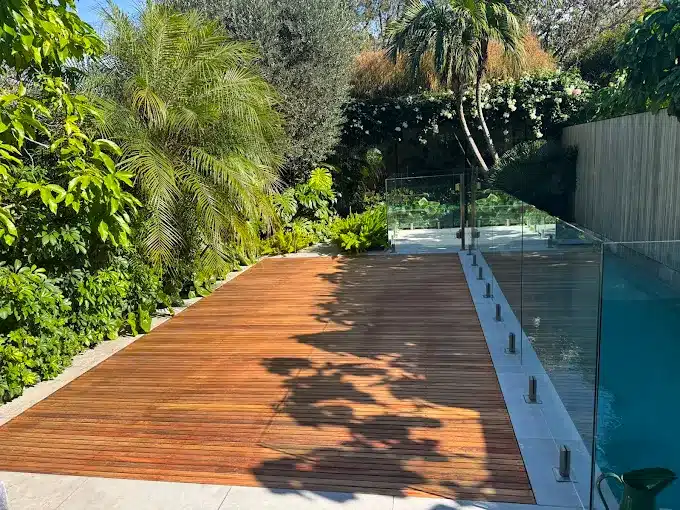
Green moss and mould had made this poolside deck dangerously slippery when wet. The owner was worried about his children’s safety. After sanding the deck back to clean timber, we added grip powder into the staining process. The finish now has a rougher texture that suits pool areas and high-traffic walkways, and the deck looks great.
We also rejuvenated Heidi’s pool deck and barbecue area. In her Google review, she says she will continue to use us for maintenance in the future.
In Australia, AS 4586 classifies the slip resistance of new surface materials, and AS 4663 covers testing of existing surfaces such as a recoated deck. The wet pendulum test rates surfaces from P0 (very low slip resistance) to P5 (very high), and a separate wet barefoot ramp test rates barefoot areas as A, B or C. Pool surrounds are generally expected to sit at the higher end of those scales.
For homeowners, the practical question is simply whether the deck feels secure when wet. For commercial sites, strata buildings, hotels and public areas, building managers may need a formal rating. In that case, the finished surface should be tested on site to AS 4663 by an accredited slip resistance tester, and we can work alongside them.
A non-slip coating is a trade-off between grip and comfort, and it is worth knowing both sides.
A non-slip finish works best on a deck that is kept clean and coated.
Our deck cleaning and maintenance programme takes care of this for you.
Slippery decks are a safety and liability issue for strata committees, hotels, building managers and real estate agents. We maintain decks and pool areas for commercial clients including JLL, Frasers Property and Crowne Plaza.
For commercial sites, we can stage the work to keep areas open, schedule around residents and guests, and set up regular maintenance so the grip and protection never lapse.
The cost of a non-slip deck coating depends mostly on the size and condition of the deck. Because the grip additive goes into the stain, it adds relatively little to a standard sand and stain. Every deck gets a free, fixed on-site quote. The main factors are:
Yes. We sand the deck, then add a grip additive to the stain to create a textured, slip-resistant finish that still shows the timber grain. It is ideal for pool surrounds.
Only slightly. The colour and grain still show through, but the surface has a fine texture and a slightly more matte appearance up close.
It is a little rougher than a standard finish, but it is designed for walking barefoot around pools. The texture is fine rather than coarse.
The grip lasts as long as the coating, usually 12 to 18 months before a maintenance recoat. Heavy-traffic paths wear faster. The grip additive is renewed at each recoat.
Usually the best result comes from building the grip into a fresh stain over sanded timber. Whether we can add grip over your existing coating depends on its type and condition, which we check during the quote.
For most homes, a grip additive mixed into the stain gives the best balance of safety, appearance and maintenance. Strips suit specific spots like stair nosings but change the look of the deck.
It helps in the short term, but mould usually returns within months unless the deck is properly coated. Combining a clean, a sand, a protective coating and a grip additive gives a lasting fix.
We do not issue slip ratings ourselves. Where a commercial site needs a formal rating, an accredited slip resistance tester can test the finished surface on site.
Upload photos of your deck, pool area or steps through our quote form or call Niall on 0449 183 440. We will show you where grip is needed most and give you a fixed price on site.